
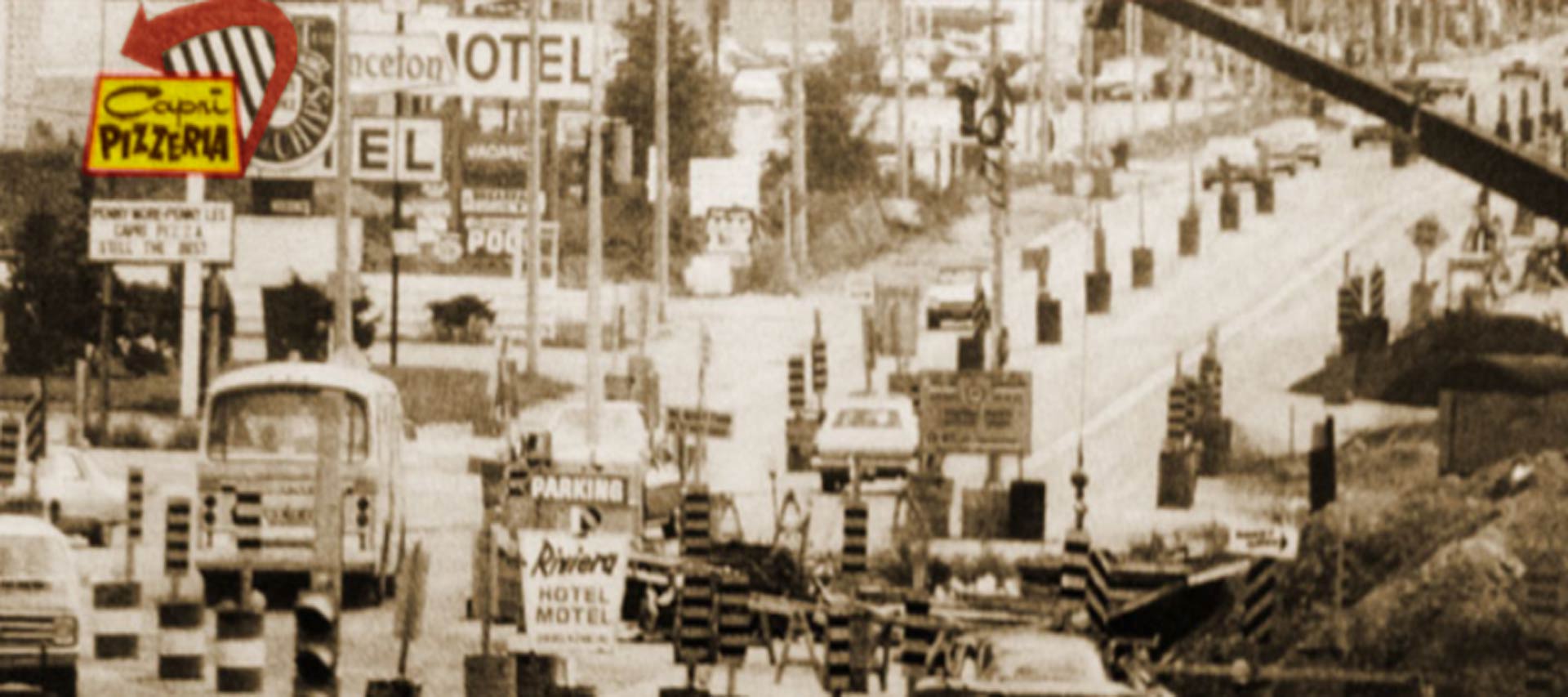
Dougall Rd when it was widened to two lanes; Capri's sign is seen on the left. Retrieved from Capri Pizzeria.
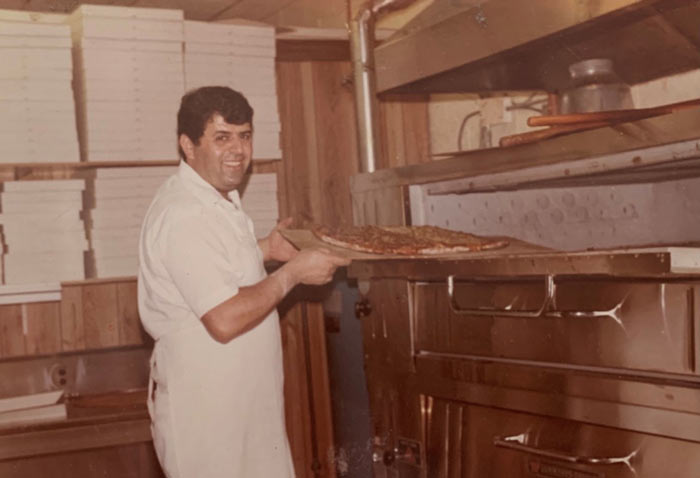
Image of Bob Kalaydjian working at Capri in 1972. Retrieved from Capri Pizzeria.
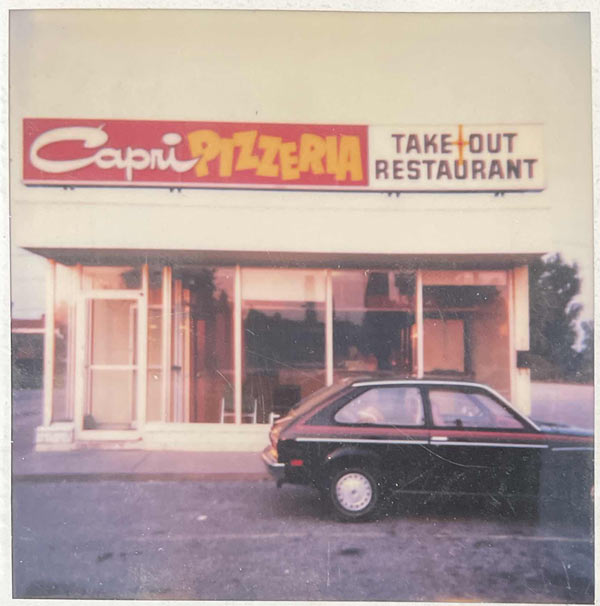
According to Capri, this was their original location. In 1987, the location moved to 3020 Dougal Rd. Retrieved from Capri Pizzeria.
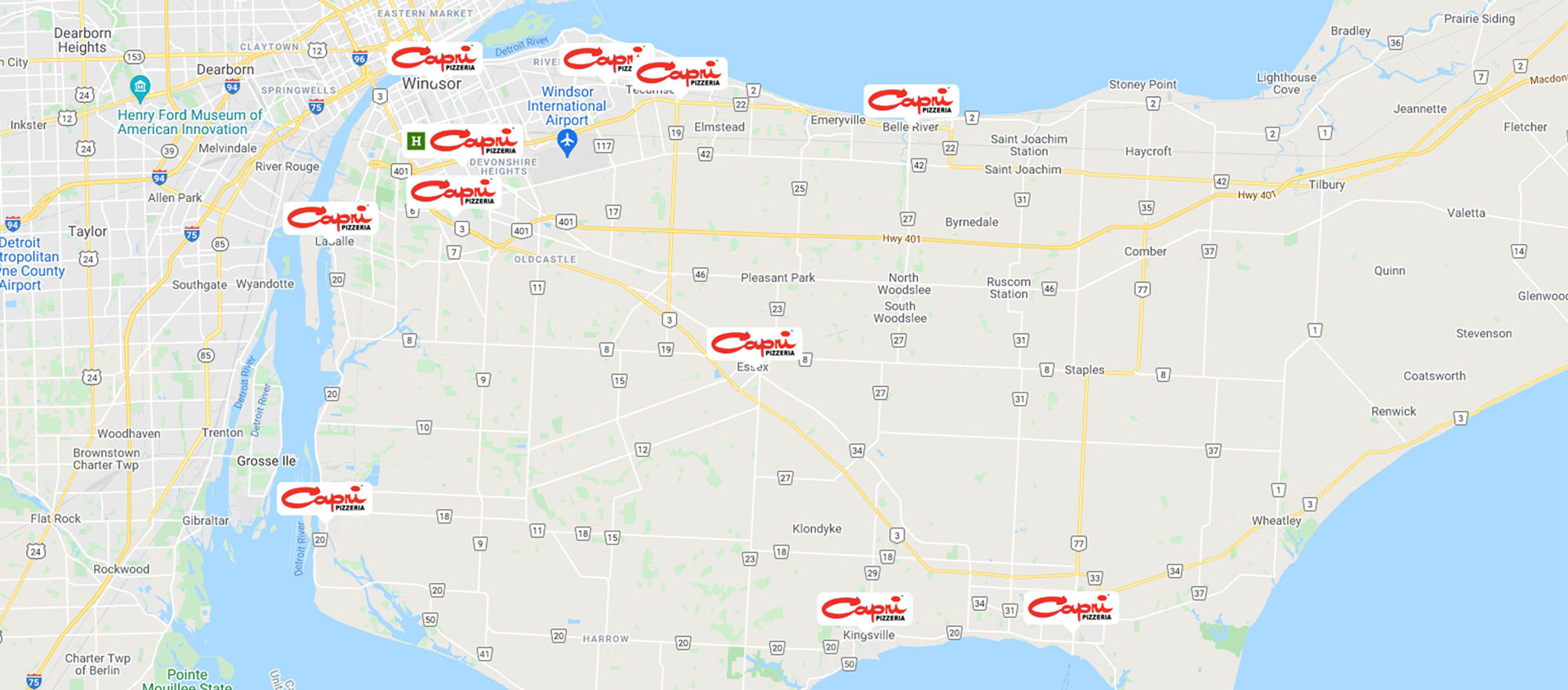
Map of the eleven Capri Pizzeria locations (including the kiosk at St Clair College). Retrieved from Capri Pizzeria.
In 1959, Tony and Vita Ciaravino opened Capri, the first pizzeria in South Windsor, at 2525 Dougall Rd. Joe Ciaravino notes that pizza was not initially the primary focus and Capri differed significantly from its current form. In June 1963, Capri moved to 3021 Dougall Rd, according to an advertisement in The Windsor Star. Tony and Vita managed Capri until 1967, when health concerns prompted them to sell the business to Dominique Vigneri, who operated it into the 1970s. In 1972, Vigneri moved Capri across the street to 3010 Dougall Rd.14 Meanwhile, Bob and Dorothy Kalaydjian gained business experience running Harvey's on University Avenue. In 1972, Bob became interested in Capri after seeing a listing and, attracted by its business hours, began working with Vigneri. The purchasing process began soon after, though the Windsor City Directories did not list the Kalaydjian family as owners until 1976, possibly reflecting a transition period and directory updates.15
After Bob Kalaydjian took ownership, Capri became a family-run business that used the traditional Windsor-style recipe passed down through generations. Bob expanded Capri with his family. In 1985, Capri opened its first franchised in Forest Glade, in the East End of Windsor, to meet the growing demand from its customer base. By 1987, the original South Windsor location had expanded and moved next door to 3020 Dougall Rd. During this period, Bob's son Kevin left for university to study economics but returned to work at Capri from the late '80s into the '90s. In 1995, Kevin began managing the main store; when the business outgrew him, he brought in Jim Koumoutsidis, who had a background in restaurants. Bob continued overseeing franchised locations. By 1997, Kevin and Jim managed all Capri locations.
When interviewed, Kevin emphasized that Capri’s commitment to quality has been fundamental to its success. The recipe has remained unchanged since the 1970s, catering to Windsor residents' preferences. Kevin explained that his customers know what Windsor-style pizza tastes like and any change would be noticed. Over time, Kevin has noted that Capri attracts skilled and dedicated staff, contributing to a loyal customer base.16 The combination of quality, service, and teamwork among employees, managers, and owners has fostered Capri’s distinctive family-oriented atmosphere.
Although Capri has maintained its foundational values, the business has adapted to evolving market standards. In 1994, Capri introduced delivery and catering services. The menu was revised, with chicken wings replacing ribs, and the business implemented billboard and coupon advertising to remain competitive with other pizzerias. By 2009, Capri operated ten franchised locations. In 2016, a Capri Kiosk was established at St. Clair College to serve students and the South Windsor Recreation Complex was renamed the Capri Pizzeria Recreation Complex. Kevin Kalaydjian attributes Capri's distinctive pizza to the experience, quality, and pride the business upholds. Today, Capri has eleven locations in Windsor-Essex.17
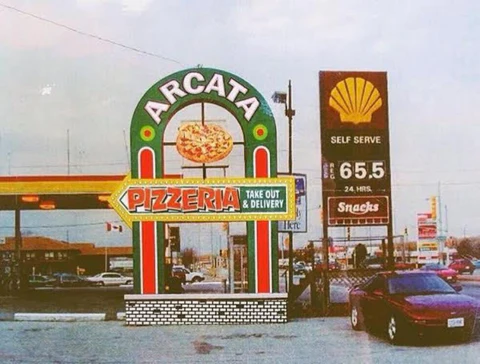
Photo of the original Arcata Pizzeria Sign on 3021 Dougall Rd. Retrieved from Rare Apparel.
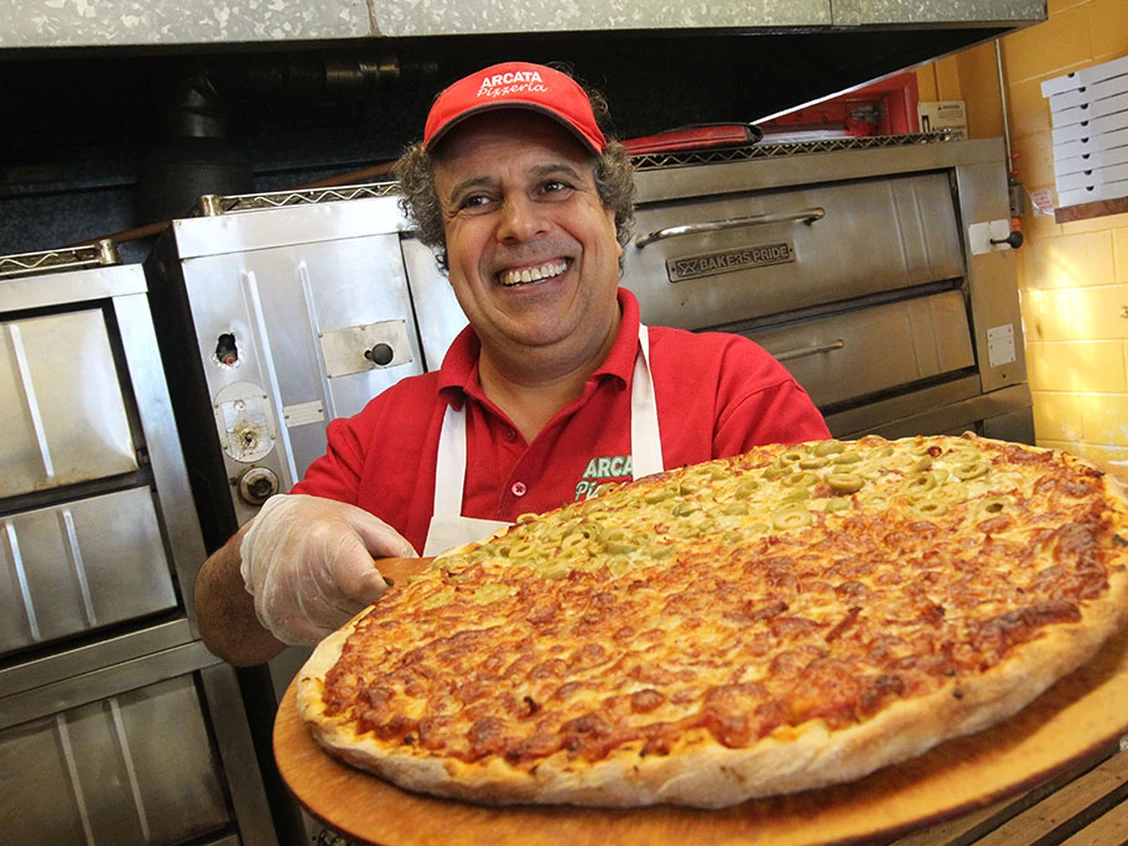
Bob Abumeeiz, owner of Arcata Pizzeria on Dougall Avenue, prepares a pizza on January 27, 2015. Retrieved from The Windsor Star.
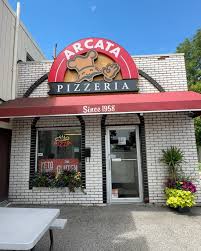
Image of Arcata Pizzeria storefront. Retrieved from Instagram @halafoodjunkie.
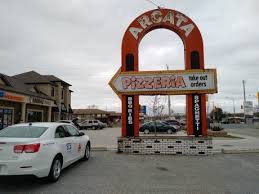
Photo of the current Arcata Pizzeria sign. The sign has deteriorated over the years. The sign was designated a neighbourhood landmark by the Windsor Municipal Heritage Register. Retrieved from Rare Apparel.
Antonino (Tony) Ciaravino continued leasing the building where Capri operated after selling the business to Dominique Vigneri. When Dominque decided to move the business across the street, Tony was unable to find a tenant, prompting him to consider launching a retail venture in the space. After this effort failed, Tony and Vita decided to return to what they knew best: pizza. In 1972, they renovated the unit and opened Arcata Pizzeria. The Arcata location at 3021 Dougall Rd has become a landmark, thanks to its towering red flashing sign. According to Joe Ciaravino, the sign was sketched using his cereal bowl. Arcata quickly became a family business for the Ciaravinos. However, by 1977, Tony’s health had rapidly declined, making it impossible to run Arcata. As a result, the decision was made to put the business and building up for sale.18
Dimitrios (Jim) Roupas immigrated to Canada from Greece at the age of 25. During an interview with Arcata's current owner, Bob Abumeeiz explained that Jim heard about a pizzeria in Windsor that needed help. Having a business background, Jim and his family moved from Nova Scotia to Windsor. Jim and his wife, Asimina, purchased Arcata in June of 1978, according to Joe. However, Arcata did not appear in the city's directory until 1979. The Roupas lived in the unit above Arcata and were a hardworking family. The family would start work at 3 p.m. and leave at 2 a.m., with all four children working and learning the business. Abumeeiz credits the Roupas with turning Arcata into the pizzeria it is today, using recipes that stemmed from Volcano. Abumeeiz explained that Jim was successful due to his incredible palate, which enabled him to create delicious pizza. Jim, Asimina, and their family were incredibly proud of their business, which they ran for eighteen years.
Abumeeiz immigrated to Canada at a young age in 1981. While in college, Abumeeiz needed a part-time job, so he took a position at Domino's Pizza and worked there for several years as an assistant manager. Later, Abumeeiz managed a convenience store in Walkerville and learned the trade of running his own business. After several years, he was burnt out and in search of something new. After a month off, Abumeeiz returned to the pizza industry, which he was somewhat familiar with. He purchased Arcata from the Rupas after they announced their retirement in June 1996. The family stayed for a few years to teach him the ropes of Windsor-style pizza. Abumeeiz credits Asimina for setting Arcata up for success under his ownership. The Roupas stayed not only to help Abumeeiz but to ease their loyal customer base, who were nervous about an unfamiliar face making their food. Abumeeiz states that it was hard at first, but through hard work, he continued Arcata's legacy.
Abumeeiz stated that the key to Arcata's success over generations was hard work and dedication. Abumeeiz works tirelessly seven days a week, open to close, because of his love and care for the pizza. Abumeeiz detailed how he has worked to create and maintain the family environment at Arcata, employing an amazing staff of high school students who feel like kids to him. This family environment is one that customers can see: positive energy and laughter. Another pillar of Arcata's success, Abumeeiz highlighted, was the use of quality ingredients. Abumeeiz explained that Arcata uses cherry tomatoes (unique to Arcata) in their sauce because of their quality and freshness. In addition, Abumeeiz has adapted Arcata over the years to represent his customers. As Windsor's immigrant population grew, it reminded Abumeeiz of his arrival in Canada. Thus, Abumeeiz has added shawarma and tandoori chicken pizzas to Arcata's menu to appeal to Arab and Indian immigrants. Although these pizzas may seem strange to traditional pizza lovers, Abumeeiz sees them as a way to connect with all Windsor residents and welcome them to enjoy pizza and the community.19 Although operating only one location, Arcata has become a staple of the Windsor-style pizza industry, built on love, dedication, and a family environment.
In 1956, 13-year-old Frank Tedesco immigrated from Cosenza, Italy, with his mother and four siblings to join Frank’s father, who had already been working in Windsor. Although his father wanted him to remain in school, Frank struggled with the language barrier and instead, chose to enter the workforce. By 1958, with jobs in Windsor becoming limited, Frank moved to Oakville to work in construction. During this time, he began cooking for himself and his roommates, developing skills that would later shape his career in the restaurant industry. When Frank was 30, he returned to Windsor and secured a job as a dishwasher at Volcano Pizzeria. He quickly worked his way up to become a short-order cook, where he learned both the craft of pizza-making and the fundamentals of running a successful restaurant. In 1963, Frank entered the restaurant industry as an owner, first opening the Colosseo Restaurant on Ottawa Street. Months later, he sold his shares and leased the Milano, formerly known as the Normandy Grill.
By 1973, Frank recognized that many customers who came for spaghetti and pizza felt out of place at Milano. In response, he opened Franco’s Spaghetti Factory and Pizza House as a family-friendly establishment. During this period, Milano remained one of the largest pizzerias in Windsor, serving Chrysler workers near the factory gates.20 However, by 1976 managing both restaurants had become increasingly difficult, leading Frank to sell Milano and focus entirely on Franco’s. By the 1980s, Franco’s had become a pizza giant in Windsor, reportedly selling as many as 900 pizzas a day and up to 3,000 on weekends. In 1984, The Windsor Star reported that Frank expected annual sales to exceed $3 million, which would be approximately $8 million in 2026 when adjusted for inflation. At the time, the restaurant employed 140 people, with as many as 22 cooks working on Friday nights. Despite this growth, Franco’s maintained its family-oriented atmosphere, with Frank’s children working in the kitchen as helpers. As early as 1985, former Windsor residents and Americans reportedly craved Windsor-style pizza. One Windsor Star article from that year noted that a man from Calgary stopped in Windsor specifically to eat the city’s pizza.21
After 33 years of ownership, Frank sold Franco’s to the Donato family, who have continued operating the business ever since. By 1997, Franco’s expanded to five locations. However, in 2026, Franco's Pizza now only operates three locations.22 Regardless of these changes, Franco’s continues to hold an important place in Windsor’s pizza history, particularly for its reputation as one of the city’s top pizzerias during the 1980s. The restaurant’s motto, “family to family,” reflects the broader culture of Windsor’s pizza industry, one rooted in immigrant labour and family environments that connected people in Windsor and beyond.
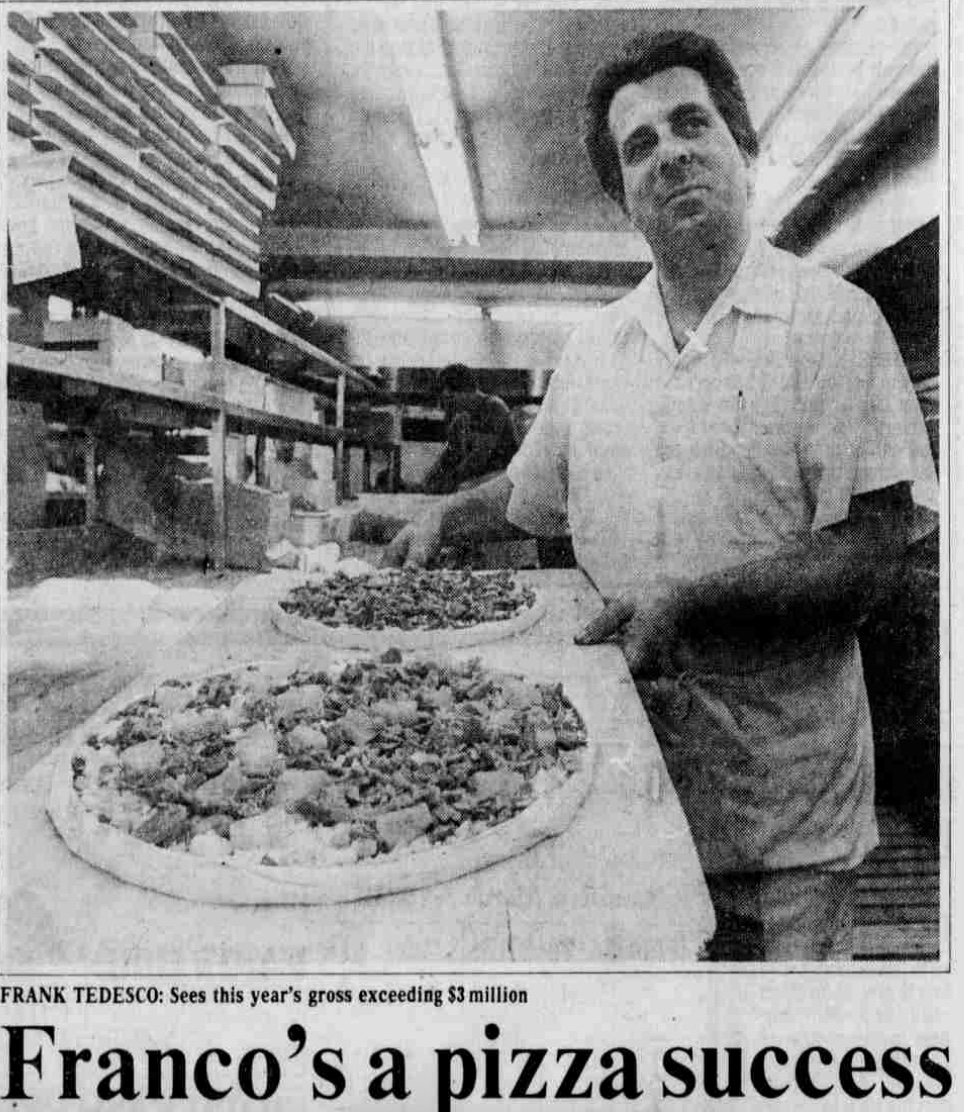
Image of Frank Tedesco holding a Pizza. Taken by Stan Andrews. Retrieved from the The Windsor Star, March 5, 1984.
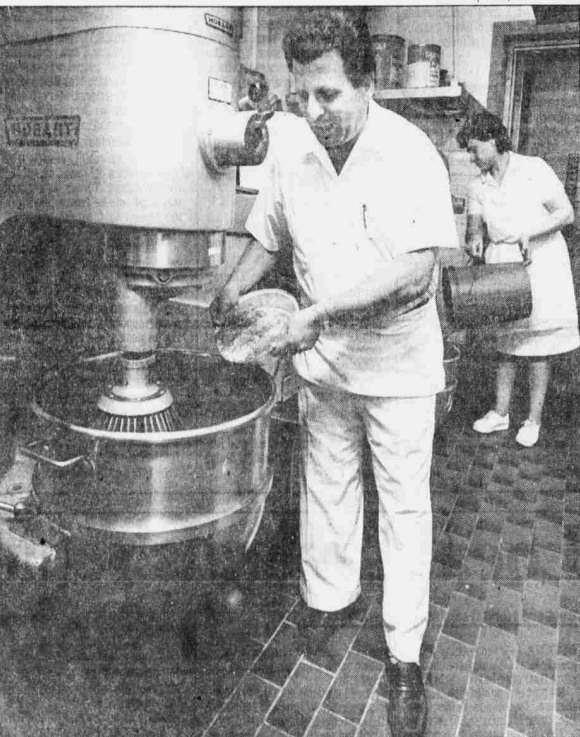
Image of Frank Tedesco making pizza sauce. Taken by Grant Black. Retrieved from The Windsor Star, March 30, 1985.
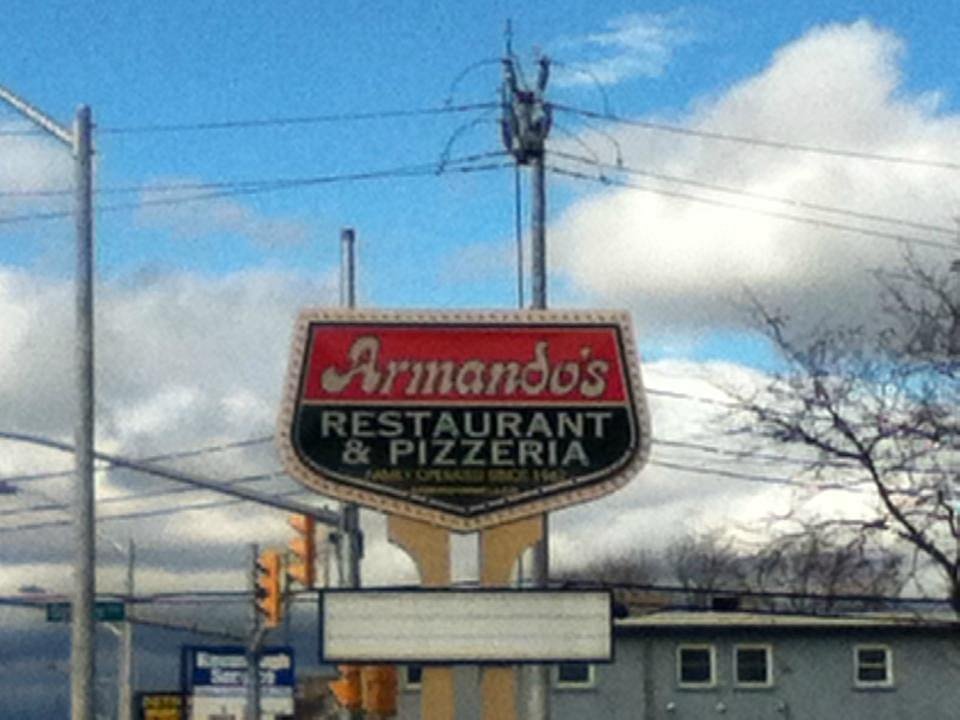
Armando's Pizzeria Sign. Retrieved from a James A.
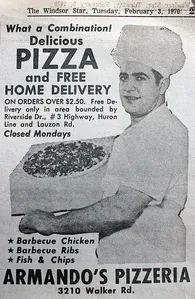
Newspaper advertisement for Armando's Pizza. Retrieved from The Windsor Star, February 3, 1970.
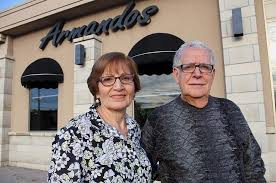
Photo of Antonia and Armando. Photo by Rebbeca Wright. Retrieved from The Windsor Star, November 15, 2017.
In the 1950s, Armando and Antonia Gerardi immigrated to Canada from Italy. Armando worked with his brother Filippo at the Italia Bakery, while Antonia was a hairdresser. At 26, Armando dreamed of opening a pizzeria, so in 1967, Armando's Pizza began in an old fish shop on Walker Rd. The couple raised three kids in the shop's small apartment. Armando managed orders, made pizzas, and served a six-table dining room alone, getting assistance from Antonia when she came home from work. At five, their son, Andre, started making pizzas and perfected his skills at twelve. Eleven years later, they moved to a larger location at 3202 Walker Rd. Antonia recalled, "I cried when that little place closed... but we outgrew it—there just wasn’t enough space."23 Although coming from humble beginnings, the hard work and dedication of Armando and Antonia encouraged Armando's success. Customers were welcomed to a family environment that produced quality pizza, which helped encourage its expansion.
In 1996, John Pizzo answered an advertisement in The Windsor Star for a pizza maker, which led him to meet Gerardi’s daughter Josie. A year later, they were married. After working at Armando’s for four years, John opened Armando’s second location on Cabana Rd. Building on this growth, Armando's expanded with a third location in Tecumseh around 2004 and later franchised it. By 2006, following Antonia and Armando’s retirement, their son, Andre, and son-in-law, John, took over the business. For Andre, honouring his parents translated into expanding the business across Ontario. Since 2006, Andre and John have pursued franchising Armando’s locations.
Today, John Pizzo is president of Armando’s Pizza, and Andre serves as vice president, overseeing 12 locations. Transitioning from the family’s involvement, the pair offers owners freedom while requiring adherence to the signature pizza recipes. John and Andre believe that allowing each restaurant its own identity brings success and variety to customers. Armando gained international recognition in 2014 at the Las Vegas Pizza Expo, with four pizzas placing in the top five of their divisions. Operating as dine-in, takeout, delivery, and catering, Armando’s employs over 400 full- and part-time staff.24 The business, rooted in a family environment, has expanded Windsor's pizza legacy across Windsor, Essex, and into America with a location in Michigan.
In 1970, 13-year-old Tony Bahceli immigrated with his family from Cyprus to Windsor, seeking refuge from growing political tensions. Tony’s father, Kemal, instilled a strong work ethic that would shape his future career. Tony secured his first job at Harvey's on Wyandotte Street West, where he learned the fundamentals of the food service industry. After gaining experience in the restaurant business, Tony began working at Chrysler Canada, where he quickly advanced to a supervisory position. Tony decided in 1983 that it was time to start his own business. The following year, he opened the first Naples Pizza location. Tony chose the name “Naples” because of the city’s reputation for exceptional food. The official website for Naples Pizza claims that its first location opened in 1984 in East Windsor. However, a 2006 article from The Windsor Starstates Naples was first opened in Amherstburg. The first location of Naples Pizza could not be independently verified; however, a 1990s advertisement showed two locations in Windsor, on Dougall and Lauzon Rd.
As the business expanded, the bakery that originally supported Naples Pizza evolved into Canadian Bread Bakers, a wholesale bakery. By 1995, Naples Pizza had grown to nine locations. When asked about the secret to his success, Tony credited his family as the foundation of the business. Continued expansion brought the company to seventeen locations by 2006, including a restaurant in London, Ontario, and to nineteen locations by 2011, including a now-closed location in Sarnia.25 Today, Naples Pizza operates twelve locations, many of which are franchised, while still maintaining the traditional Windsor-style pizza recipe. Like many other Windsor pizzerias, Naples was the product of a hard-working immigrant who built a business off of a tradtional recipe and instilled the importance of family.
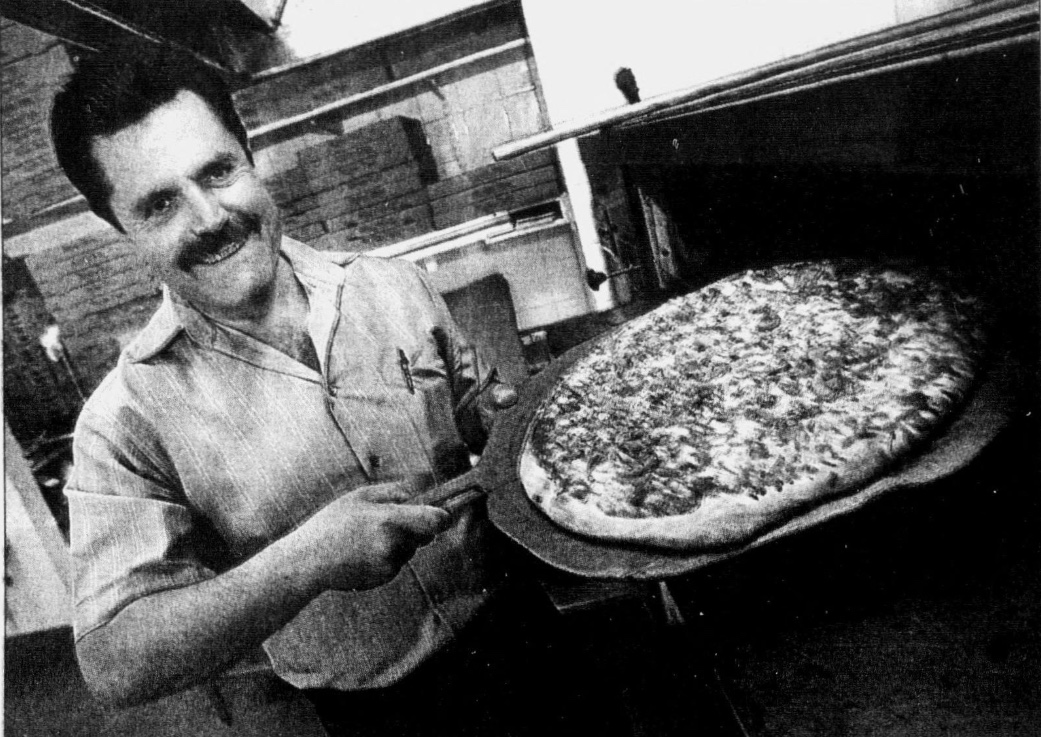
Photo of Tony Bahceli, founder of Naples Pizza. Photo by Tyler Brownbridge. Retrieved from The Windsor Star, 2006.
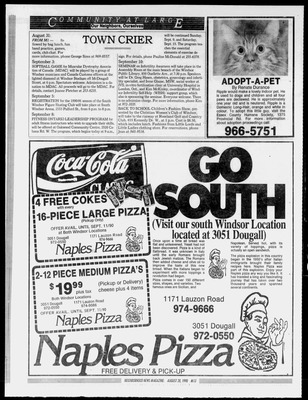
Advertisement for Naples Pizza. Retrieved from the The Windsor Star, August 28, 1990.
Use this lesson about Windsor-style pizzerias in your classroom. The provided lesson is best suited for Grade 10 History and Grade 11 Food and Culture.
Download Lesson Plan PDF Download Activity Package Download Sorting Cards Download Windsor-Style Pizzerias Slides